Psychache: a dialogue on suicide and psychological suffering
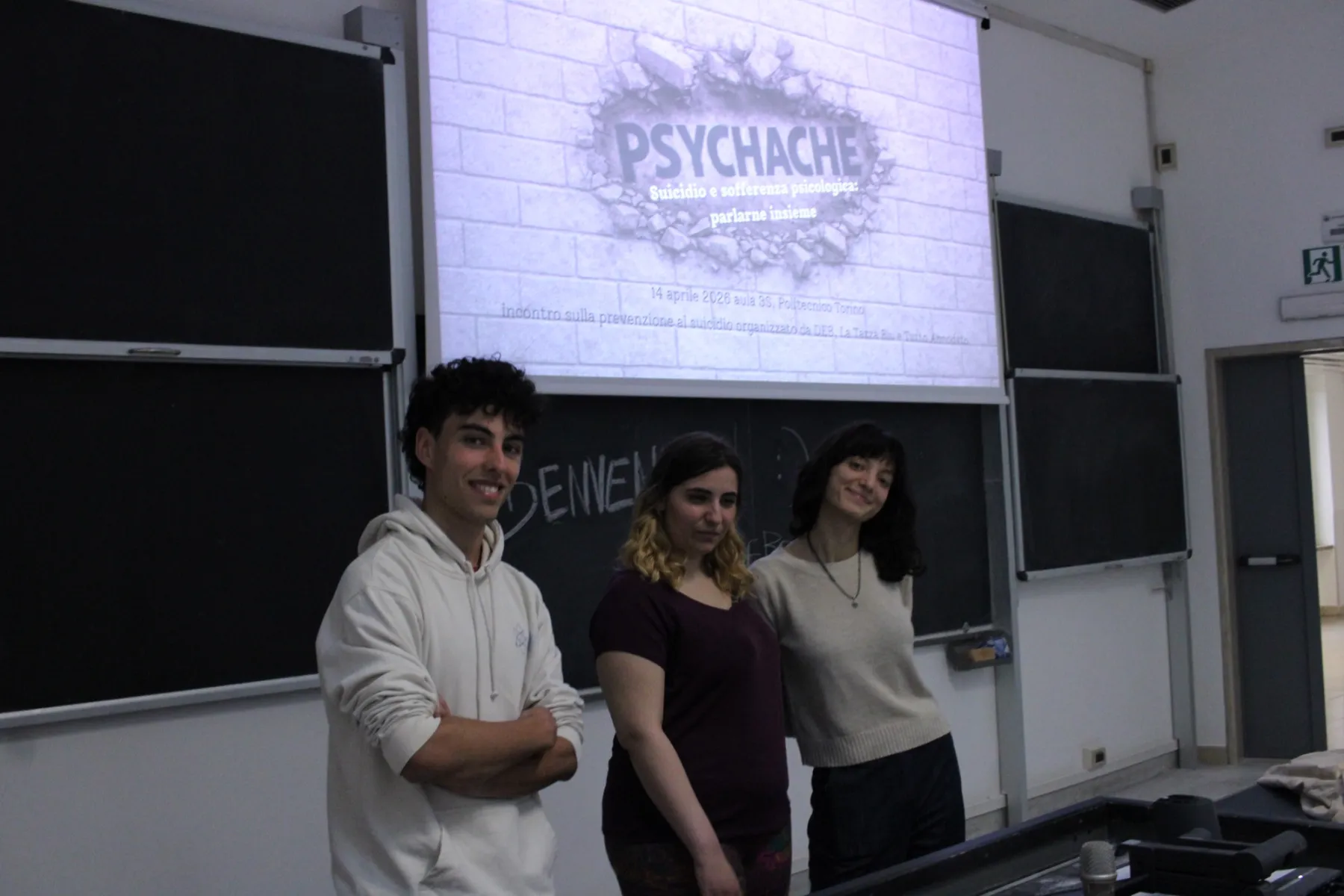
On April 14, with La Tazza Blu and Tutto Annodato, we opened a space at Politecnico to talk about suicide: data, the results of our student survey, an open discussion and practical advice. Here you can also download our zine.
If you are thinking about suicide or are worried about someone, you can talk to someone right now. You’ll find the contacts at the end of this page. In an emergency, call 112.
Psychache: the pain you can’t see
🧠 “Psychache” is a word for deep psychological pain, often invisible, that can make it hard to keep living. The term was coined by the American psychologist Edwin Shneidman, one of the founders of suicide prevention studies. It is not a diagnosis: it is a human experience made of suffering, loneliness and the feeling of being shut in. Talking about it means learning to notice this pain before it becomes unbearable.
On April 14, 2026, in room 3S at Politecnico di Torino, we held a meeting on suicide prevention together with two associations:
- La Tazza Blu ODV, founded in 2019 by the parents of a young woman who died by suicide, together with volunteers and other parents who have lived the same loss
- Tutto Annodato, a project started by six young people after the suicide of a schoolmate, so that mental health would stop being a taboo
Why talk about it
Suicide is still a subject many people find uncomfortable, and that silence makes it harder to ask for help. We wanted to start breaking it with small steps, starting from each of us and from every word said out loud.
We set a few ground rules at the start: it was not a lecture but a conversation; everyone could speak out loud or in writing, and could leave the room at any time for any reason; and we would try to use the word “suicide” instead of avoiding it. We chose not to discuss assisted suicide and euthanasia.
What the numbers say
We shared some data to give a sense of how big the problem is:
- According to a 2025 WHO report, about 720,000 people die by suicide every year in the world, roughly one every 40 seconds
- In Italy there were 3,741 suicides in 2023 (ISTAT). Piedmont recorded 406, more than in previous years, and has the third highest suicide rate in Italy
- According to Politecnico’s own 2023-2024 report on quality of life, almost 1 student in 3 (30.9%) reports distress, loss of confidence and low involvement in their studies, up from 20% in 2021. 12% of PhD students are in burnout. No official data has been published on suicidal thoughts.
Our survey
Before the event we ran an anonymous survey among students and presented the results. Some of the findings:
- Loneliness and feeling like a disappointment to one’s family were the factors most strongly linked to suicidal thoughts
- International students find it harder to feel part of university life: about 1 in 4 has lost someone close to suicide, compared with about 1 in 10 among local students, and they are less likely to talk about it
- 83.5% of the people most at risk said they didn’t know any of the services that could help them
That last number is one of the main reasons we made the zine.
Open discussion
The second part of the evening was for the people in the room. Anyone could raise their hand or write in through an anonymous form, and many people shared questions, thoughts and personal experiences. Thank you to everyone who spoke, and to everyone who listened. 🌿
Some practical advice
We closed with advice that came out of our work and from the booklet Navigating Crisis by the Icarus Project.
For yourself:
- Write a list of the people you care about, focusing on the time you still want to spend with them
- Write a list of things you would miss doing, from your favorite music or food to the goals you want to reach
- Write down your thoughts, to notice what triggers them and how they change over time
If you want to help someone:
- Ask them directly if they are thinking about suicide, and talk about it openly. Asking does not put the idea in their head; it can be a big relief
- Help with small daily tasks: in a hard moment even simple things can feel impossible
- Make a crisis plan together: common triggers, a list of trusted people to call, maybe a code word to ask for help quickly
- If someone tells you they have suicidal thoughts, show them they have found a safe place to talk. Listen without judging. It is not a tragedy, but it must never be ignored or played down
We ended with a few questions for everyone: what can I do in my daily life? What are my university and my city doing, and can I ask them to do more? What should the State invest in to improve mental health care?
Download the zine
In our zine, Psychache: dialogue as an act of suicide prevention, you’ll find how to recognize the warning signs, how to help yourself and the people around you, a list of associations, projects and emergency numbers, and professionals in Turin who offer affordable psychological support to young people and students.
Download the zine here: https://cdn.eu.dialogueexplorebond.it/events/2026-04-14/fanzine.pdf ✨
Who you can contact
- 📞 Telefono Amico Italia: emotional support by phone at 02 2327 2327, 24/7; WhatsApp 324 011 7252, every day from 6 to 9 PM
- 💙 La Tazza Blu: listening with mental health professionals, WhatsApp 375 693 4966, Monday, Wednesday, Friday and Sunday, 7 to 10 PM
- 🤝 DEB: free and anonymous peer listening on Telegram at @DialogueExploreBondBOT, Monday to Friday, 6 to 10 PM
These are not emergency or therapy services. In an emergency, call 112.
You’re not alone, we’re here for you.
DEB, Tutto Annodato and La Tazza Blu